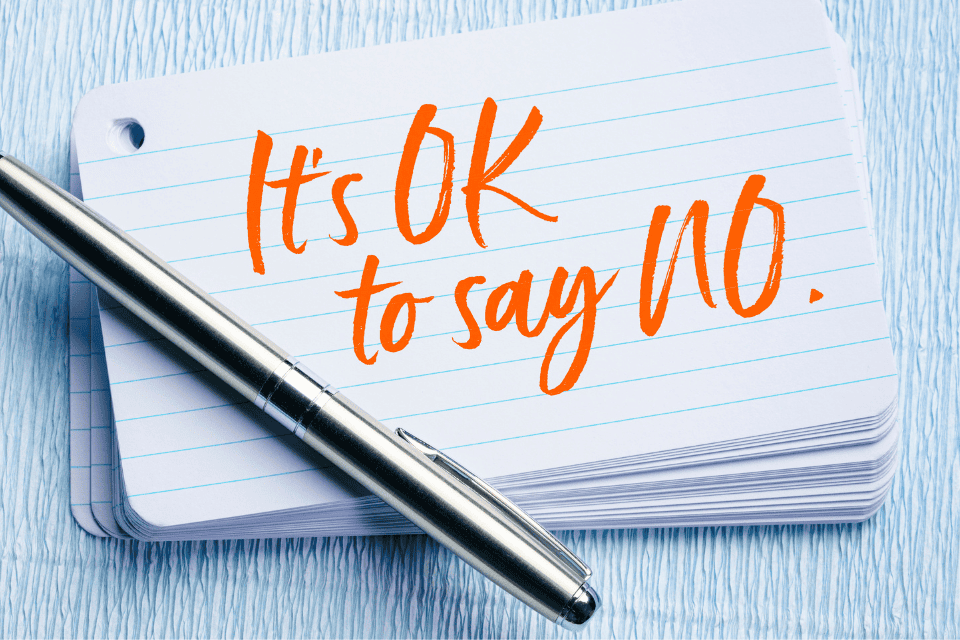
If you’re a carer, you’ve probably said “yes” when every part of you was quietly screaming “no”.
Yes to one more favour. Yes to another appointment. Yes to staying late. Yes to solving problems that aren’t yours to solve — because it feels easier than conflict, guilt, or letting someone down.
But here’s the truth carers need to hear clearly:
Boundaries aren’t selfish. They’re how care stays loving, safe, and sustainable.
Without boundaries, caring can turn into depletion, resentment, burnout — and relationships begin to fray.
This is a compassionate guide to saying “no” in a way that protects your health, keeps your care steady, and helps others understand what’s realistic.
Three things to remember first
A kind “no” is often more loving than a resentful “yes”.
Overcommitting doesn’t make you better — it makes you drained.
Boundaries aren’t walls. They’re pathways.
They don’t say “I don’t care.” They say, “Here’s how I can care without breaking.”
You’re allowed to have limits — even with people you love.
Especially with people you love.
The real reason saying “no” feels so hard
Carers often struggle with boundaries because they’re driven by powerful values:
- responsibility
- loyalty
- compassion
- duty
- fear of things falling apart
But caring can also train you into patterns like:
- “If I don’t do it, no one will.”
- “It’s easier to just handle it myself.”
- “If I set limits, I’ll look selfish.”
- “If I say no, someone will be upset.”
Here’s the shift:
someone being disappointed is not the same as you doing something wrong.
Discomfort is not danger. It’s just discomfort.
How to say “no” kindly — without over-explaining
One of the biggest traps carers fall into is giving long explanations, hoping people will approve of the boundary.
You don’t need approval. You need clarity.
Use this simple 3-part Kind Boundary Formula:
Warm start + Clear limit + Next step
Warm start: “I understand / I hear you / I want to help…”
Clear limit: “…but I can’t do that.”
Next step: “What I can do is…”
Examples:
- “I hear you. I can’t do tonight. I can do tomorrow at 2.”
- “I want to help, but I’m not available for that. I can do X instead.”
- “I understand it’s urgent. I can’t do it safely. What support options are available?”
This is kindness with structure — and structure reduces guilt.
Boundaries for the three hardest groups
With loved ones
Family boundaries are emotional. They can trigger guilt, history, and fear.
Try:
- “I can help, but I can’t carry this alone. Let’s share the tasks.”
- “I’m not able to talk about this right now. I’ll talk after dinner.”
- “I can do one thing today — which one matters most?”
- “If we keep doing it this way, I won’t cope. We need a new plan.”
The goal isn’t to be harsh. It’s to be sustainable.
With professionals
Carers often feel rushed, spoken over, or expected to absorb impossible responsibility.
Try:
- “Please explain that again slowly — I want to get it right.”
- “I can’t do that safely at home. What alternatives do we have?”
- “I need this written down — can you email or print it?”
- “I’m available between 10 and 12 — can we schedule within that window?”
Good professionals respect clear boundaries. If someone doesn’t, that’s information — not a reason to abandon your limits.
With employers
Work + care is where burnout often accelerates, because carers try to be “perfect” in both roles.
Try:
- “I can do my role well with predictable hours.”
- “I can’t stay late today. I can start earlier tomorrow.”
- “I need a temporary adjustment to keep work sustainable.”
- “I’m committed to the job — and I need a pattern that’s realistic.”
Boundaries at work aren’t a weakness. They’re professional self-management.
The “Boundary Ladder”: start small, build confidence
You don’t have to leap straight into big boundaries. Try stepping up gradually:
Level 1: Delay
“Let me come back to you later today.”
Level 2: Limit
“I can do 30 minutes, not two hours.”
Level 3: Decline
“I can’t take that on.”
Level 4: Protect
“I’m not available outside these hours.”
Small boundaries build muscle. Confidence follows practice.
When guilt shows up (because it will)
Guilt often appears when you do something healthy but unfamiliar.
Try this reframe:
- “This boundary isn’t rejection — it’s protection.”
- “Saying no is how I keep showing up long-term.”
- “I’m allowed to have limits.”
You can be kind and still be clear.
In fact, clarity is kindness.
A real carer’s voice
Aisha, who supports her dad while raising children and working part-time, told us:
“I thought boundaries would make me a bad daughter. But they made me a healthier one. I stopped saying yes out of fear — and started saying yes from choice.”
That’s what sustainable care looks like: care that comes from strength, not depletion.
Your boundary is part of your care
A boundary doesn’t mean you care less.
It means you’ve decided your health, safety, and humanity matter too.
And they do.